What we look for
- Tea and coffee services — three-, five- and seven-piece sets, American, English and Continental, with or without the tray. Kettles on stands, hot-water urns and chocolate pots too.
- Trays, salvers and waiters — from a small card tray to a two-handled gallery tray that takes two people to carry.
- Candelabra and candlesticks — pairs and sets of four especially; convertible candelabra with their original arms.
- Hollowware — bowls, pitchers and ewers, compotes, covered vegetable dishes, tureens, baskets, wine coolers, cups and trophies.
- Early and collectible silver — Georgian and Victorian English pieces, American coin silver, Continental 800 and 830 standard, Arts & Crafts and Art Deco makers, and old Sheffield plate of the fused kind.
- Maker-marked pieces — Tiffany & Co., Gorham (especially Martelé and the special-order lines), Kirk and Stieff repoussé, Georg Jensen, Paul Storr and the London makers, Puiforcat, Buccellati.
- Silver-mounted things — dresser sets, claret jugs, cane handles, frames, inkwells and desk pieces.
What makes a piece worth more than its metal
With antique silver the metal is the least interesting thing about it. What we are reading when we turn a teapot over:
- The maker. A clear maker's mark from a sought-after workshop changes everything; an unmarked or retailer-only piece is judged on its quality alone.
- The period and the form. A Georgian coffee pot, a Victorian naturalistic tea service and a 1930s Jensen bowl appeal to different collectors — and rare forms (a kettle on stand, a monteith, a wine cooler) outrun common ones.
- The quality of the work. Hand-chasing, cast borders, crisp engraving and good weight in the hand, as opposed to thin, stamped, machine-finished pieces.
- Condition and honesty. Original surface, no splits, no erased monograms, no later decoration, handles and finials that belong. A little wear is fine; a heavy repair is not.
- Completeness. The tray that matches the service, the liner that belongs to the tureen, both of a pair.
Reading the marks
Turn the piece over. American silver usually says STERLING or 925 beside the maker's mark. English silver carries a row of small punches — a lion passant for the standard, a town mark, a date letter and the maker's initials — which between them tell you where and in which year it was assayed. Continental pieces read 800, 830 or 835. Early American pieces may read COIN or carry only a silversmith's name — bring those in; some are the best things we see. Our guide to reading silver hallmarks walks through each system.
Plate is a different thing: EPNS, EP, A1, Quadruple plate, or a maker's name with no standard mark. Good, heavy, older plate — a fine Victorian tea service, a handsome gallery tray — is decorative and saleable, and we buy it as what it is. Weighted candlesticks and trumpet vases are thin silver over a filled core; they are priced as objects, by the pair, on their looks.
Before you bring it in
- Don't polish it. Tarnish comes off; over-polishing takes the crisp detail — and the value — with it.
- Keep the pieces together — the whole service, the tray, the liners, the fitted case if there is one.
- Photograph the marks if you'd like an opinion by email: the base of the teapot, the underside of the tray, close enough to read.
- Bring what you know — a receipt, an old appraisal, the family story of where it came from. Provenance is part of the object.
Buy, consign, or auction?
Most good silver sells best to us, outright. A rare Georgian piece, a Jensen service, a great American maker in original condition, or a piece with a documented history can do better at a specialist sale — and when that's true we'll say so, and place it for you. A fine service you're in no hurry to sell can also go on our floor on consignment. For a whole house of silver, china and furniture, see our estate services.
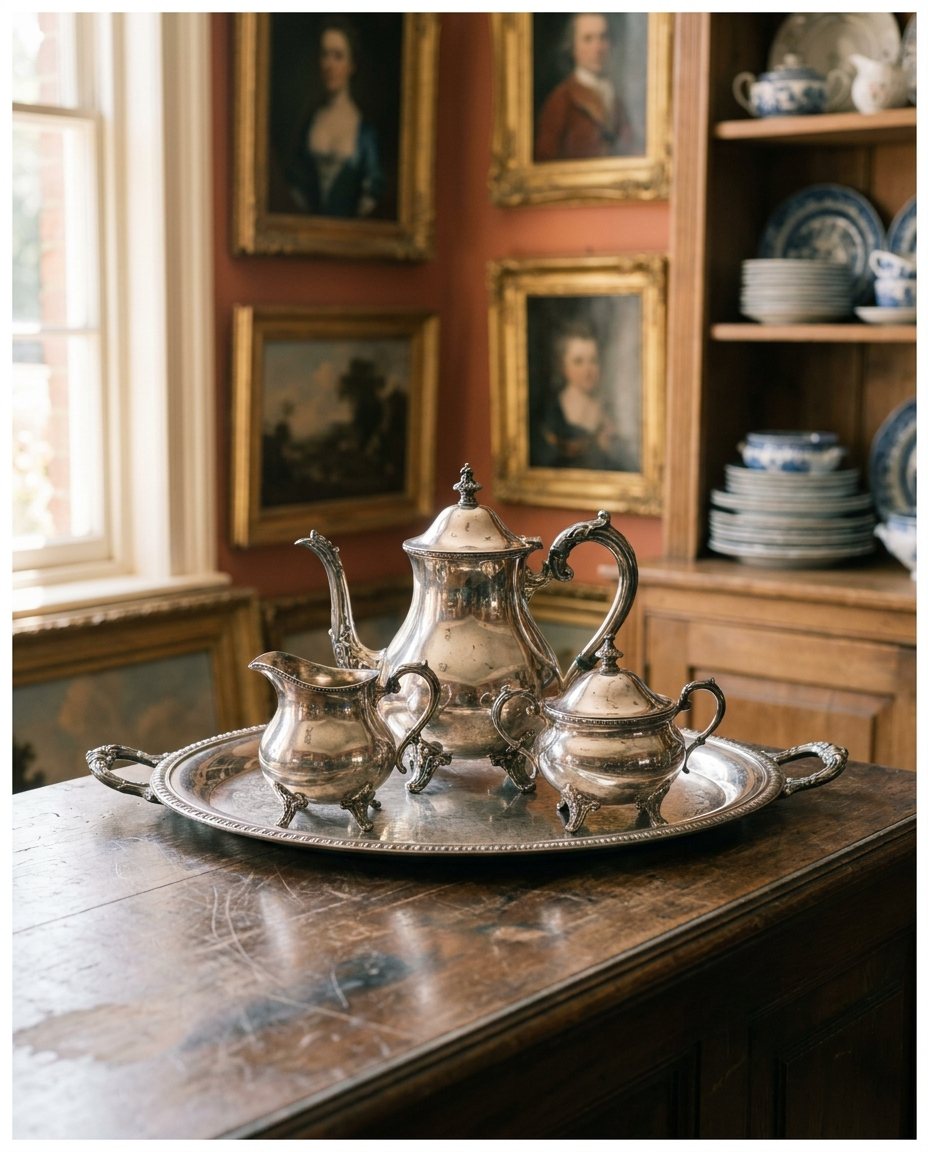 the sort of thing we look for